The Best Hotels and Resorts in Sisaket Province
Sisaket (Thai: ศรีสะเกษ, RTGS: Si Sa Ket), is one of the northeastern provinces (changwat) of Thailand. Neighboring provinces are (from west clockwise) Surin, Roi Et, Yasothon, and Ubon Ratchathani. To the south it borders Oddar Meancheay and Preah Vihear of Cambodia.
The province is in the valley of the Mun River, a tributary of the Mekong. The Dângrêk mountain chain, which forms the border with Cambodia, is in the south of the province.
Khao Phra Wihan National Park covers an area of 130 km² of the Dângrêk mountains in the southeast of the province. Established on March 20, 1998, it is named after a ruined Khmer Empire temple Prasat Preah Vihear (anglicised in Thailand as Prasat Khao Phra Wihan), now in Cambodia, which had been the issue of boundary dispute. The temple faces north and was built to serve the Sisaket region. Earlier maps had all shown it as inside of Thailand. However, a boundary survey conducted by the French for the Franco-Siamese Treaty of 1907 deviated from the agreed-upon international divide by watershed in order to place the temple on the French (Cambodian) side.
The Thai government ignored the deviation and continued to regard the temple as being in Sisaket Province. In the mid 1950s, newly independent Cambodia protested the Thai "occupation" of what the French map showed as theirs. Since the French map was clearly incorrect, in 1962 the Thai government confidently agreed to submit the dispute to the International Court of Justice. To their dismay, the court voted 9 to 4 to confirm the border as shown in 1907 map and awarded the temple to Cambodia. Access to the temple is still principally from the Thai side, as the ruins are difficult to reach from the Cambodian plains at the bottom of a sheer cliff several hundred meters below. The Cambodian government has expressed interest in building a cable car to carry tourists to the site, though this has yet to happen, pending resolution of the ownership of other areas in the Cambodian–Thai border dispute.
Sisaket (Thai: ศรีสะเกษ, RTGS: Si Sa Ket), is one of the northeastern provinces (changwat) of Thailand. Neighboring provinces are (from west clockwise) Surin, Roi Et, Yasothon, and Ubon Ratchathani. To the south it borders Oddar Meancheay and Preah Vihear of Cambodia.
The province is in the valley of the Mun River, a tributary of the Mekong. The Dângrêk mountain chain, which forms the border with Cambodia, is in the south of the province.
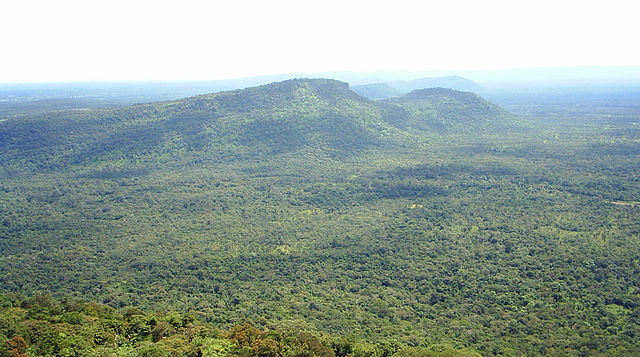
Khao Phra Wihan National Park covers an area of 130 km² of the Dângrêk mountains in the southeast of the province. Established on March 20, 1998, it is named after a ruined Khmer Empire temple Prasat Preah Vihear (anglicised in Thailand as Prasat Khao Phra Wihan), now in Cambodia, which had been the issue of boundary dispute. The temple faces north and was built to serve the Sisaket region. Earlier maps had all shown it as inside of Thailand. However, a boundary survey conducted by the French for the Franco-Siamese Treaty of 1907 deviated from the agreed-upon international divide by watershed in order to place the temple on the French (Cambodian) side.
The Thai government ignored the deviation and continued to regard the temple as being in Sisaket Province. In the mid 1950s, newly independent Cambodia protested the Thai "occupation" of what the French map showed as theirs. Since the French map was clearly incorrect, in 1962 the Thai government confidently agreed to submit the dispute to the International Court of Justice. To their dismay, the court voted 9 to 4 to confirm the border as shown in 1907 map and awarded the temple to Cambodia. Access to the temple is still principally from the Thai side, as the ruins are difficult to reach from the Cambodian plains at the bottom of a sheer cliff several hundred meters below. The Cambodian government has expressed interest in building a cable car to carry tourists to the site, though this has yet to happen, pending resolution of the ownership of other areas in the Cambodian–Thai border dispute.
Comments
Post a Comment